
Plasma Pen Fibroblast Skin Tightening Perth
Plasma Pen fibroblast is a non-surgical cosmetic skin tightening treatment. A fine tip is held just above the skin and a controlled arc of plasma energy treats a precise point, which contracts the tissue immediately and prompts the fibroblast cells in the dermis to build new collagen and elastin over the weeks that follow.
It is used for cosmetic skin tightening and wrinkle softening only — hooded upper eyelids, crow’s feet, forehead and frown lines, fine lines around the eyes and mouth, nasolabial folds, and crepey skin on the cheeks, jawline and neck. It suits adults with mild to moderate laxity who want visible tightening without surgery and can accommodate a visible healing period.
Expect a grid of small carbon crusts across the treated area for roughly five to seven days, swelling that is most noticeable on the first two days, then pink skin that settles over two to four weeks. Collagen change continues for about six to twelve weeks. Improvement varies between individuals and Plasma Pen is not a substitute for surgery where laxity is significant.
Plasma Pen fibroblast is a cosmetic treatment. Results differ from person to person and no outcome can be guaranteed. ELKA CLINIC does not diagnose skin conditions or eyelid disorders — where a medical or surgical opinion is the right starting point, we will say so. Flexible payment plans are available for all treatments.
Who Performs Plasma Pen Fibroblast At ELKA CLINIC
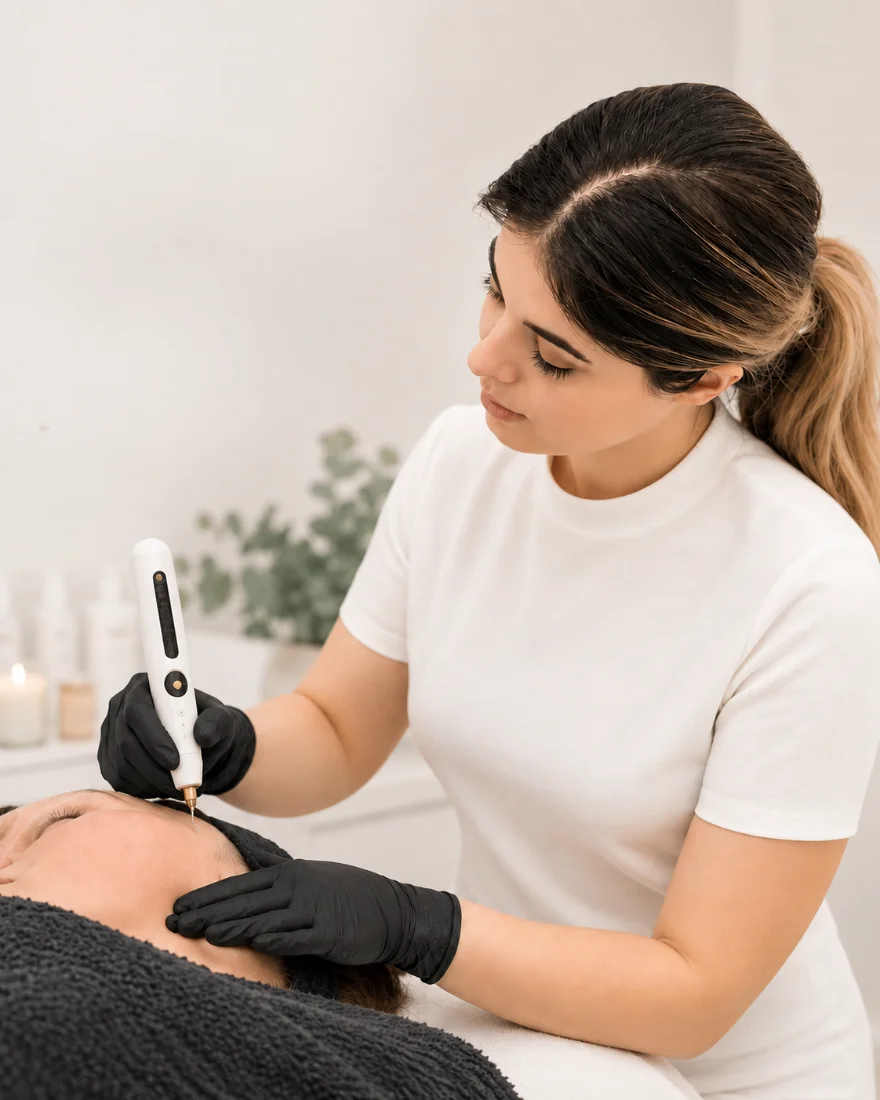 Maryam, Senior Skin Therapist, ELKA CLINIC Subiaco
Plasma Pen fibroblast at ELKA CLINIC is performed by Maryam, our Senior Skin Therapist, who carries out the skin treatments at the clinic. ELKA CLINIC has operated in Subiaco since July 2015 and was founded by Ellie, Founder & CEO, who leads the team and still consults.
Fibroblast is judged as much by restraint as by technique. Depth, spacing and energy are set for the area and for the skin in front of us, and the eye area is treated in stages rather than in one heavy session.
Suitability is confirmed in person. If the concern turns out to be lost volume, movement lines or skin genuinely in excess, we explain which treatment or which specialist would serve you better rather than proceed.
Read more about the ELKA CLINIC team, their training and how the clinic works. This page was written by the ELKA CLINIC clinical team and last reviewed in August 2026. It is general information about a cosmetic treatment and is not medical advice or a diagnosis.
What Is Plasma Pen Fibroblast?
Plasma Pen fibroblast is a non-surgical cosmetic treatment that tightens loose skin and softens wrinkles by creating a controlled pattern of tiny, precisely spaced injuries in the surface of the skin. Each point contracts the tissue around it straight away, and the healing response that follows asks the fibroblast cells in the dermis to produce new collagen and elastin.
Nothing is injected, nothing is cut, and no filler or muscle relaxant is used. The tightening comes from the skin’s own repair process, which is why the visible change builds gradually over six to twelve weeks rather than appearing on the day.
How plasma energy works
The device does not touch the skin. Nitrogen and oxygen in the air between the tip and the surface are ionised, creating a brief arc of plasma that delivers a very small, shallow packet of thermal energy to a single point in the epidermis. The skin between the points is left intact, so the area heals from many directions at once.
The fibroblast response
Fibroblasts are the cells in the dermis responsible for producing the structural proteins that keep skin firm. They are not consistently active in mature skin, and a controlled injury is one of the recognised ways to recruit them. Each treated point becomes a small site of repair, and fibroblasts migrate towards it. The treatment is named after this response rather than after the device.
Collagen and elastin
Once activated, fibroblasts lay down new collagen, which gives skin its firmness, and elastin, which allows it to recoil. New collagen is deposited in a disorganised form first and is progressively reorganised into stronger, better-aligned fibres over several weeks. This remodelling phase is the reason the final appearance of a fibroblast treatment is judged at around twelve weeks, not at two.
Skin contraction
There is also an immediate mechanical effect. Heat shortens the collagen already present, drawing the skin between the treated points together. On thin, mobile skin such as the upper eyelid this is often visible as soon as swelling settles. The effect is genuine but modest; it works with the skin you have.
Healing
Within a few hours each treated point develops a tiny dark carbon crust. These are the dressing the skin makes for itself, protecting the new surface while it forms. Interfering with them is the single most avoidable cause of a poor outcome. The recovery timeline sets out the stages day by day.
Plasma arc, not contact
The tip is held a fraction above the skin. Energy crosses the gap as a brief plasma arc, so nothing presses into the tissue.
A precise, shallow point
Each arc affects a very small point in the surface layer, with healthy untreated skin left between every point.
Immediate contraction
Heat shortens existing collagen fibres, drawing the skin between the points together. Loose skin looks tauter once swelling settles.
Fibroblasts recruited
The controlled injury signals fibroblasts in the dermis to move towards each point and begin producing new structural protein.
New collagen and elastin
Fresh collagen and elastin are laid down through the following weeks, gradually improving firmness and the quality of the surface.
Remodelling and settling
New fibres are reorganised over roughly six to twelve weeks. This is the period in which most of the visible change appears.
You may see this treatment described as plasma fibroblast, fibroblast skin tightening, plasma skin tightening or soft surgery. These describe the same category of treatment. It is a cosmetic procedure, not surgery, and it does not remove skin or fat.
Want to see what the skin actually looks like on day two?
The healing stage is the part most people underestimate. See the immediately-after photographs and what the carbon crusts look like before you decide on timing.
What Plasma Pen Fibroblast Can Improve
Cosmetic concerns only, and each one is assessed in person before treatment is agreed. Nothing below is treated on request alone.
Eyes, brow and forehead
- Upper eyelids. Loose or hooded upper lid skin that sits low on the lash line, where the aim is a lifted, more open eye without surgery. The most requested area at the clinic and the one where thin, mobile skin responds most visibly.
- Crow’s feet. The fan of fine lines at the outer corner of the eye. Both the etched lines and the crepey quality of the skin around them can soften, although lines that only appear when you smile respond less than those visible at rest.
- Lower eyelids. Fine crepey texture on the lower lid can be treated cautiously in selected cases. Plasma Pen does not remove fat pads, so true under-eye bags and puffiness are not an appropriate target.
- Forehead wrinkles. Horizontal lines across the forehead. Treatment addresses the skin itself rather than the muscle movement that creates the lines, so improvement is in depth and texture rather than complete erasure.
- Frown lines. The vertical lines between the brows. These are strongly movement-driven, so expectations are set carefully and treatment is aimed at softening the etched line rather than stopping the frown.
- Fine lines. Fine, shallow lines on the temples, upper cheeks and beside the eyes, where the surface has lost density rather than the area having sagged.
Mid-face, mouth and neck
- Smile lines. Lines running from the nose towards the corner of the mouth, treated with the aim of softening the surface line and firming the skin beside it.
- Nasolabial folds. The fold itself is partly structural, so a fold caused by volume loss or by mid-face descent is not corrected by tightening the skin. Where the skin beside the fold is crepey and lax, tightening can make the fold read as less abrupt.
- Around the mouth. Fine vertical lines on the upper lip and the skin immediately around the mouth. This area is sensitive and heals with more redness than most, so it is planned rather than added on.
- Crepey skin. Thin, finely wrinkled skin that gathers when pinched — commonly on the eyelids, beside the eyes, on the cheeks and on the neck. One of the more reliably improved qualities.
- Loose skin. Mild to moderate laxity, where the skin has lost recoil but has not descended significantly. Marked sagging, heavy jowls and excess skin are beyond what a surface treatment can address.
- Neck. Crepey, finely lined skin on the front and sides of the neck. Treated conservatively, usually over more than one session, because the neck heals more slowly than the face and is less forgiving of aggressive settings.
Plasma Pen fibroblast treats skin quality and mild to moderate laxity. It does not replace lost volume, does not relax muscles and does not remove fat. Where the underlying concern is volume, muscle movement or significant excess skin, tightening the surface will disappoint, which is what the assessment is for.
Treatment Areas, And What Each One Realistically Offers
What each area offers, what it asks of you in healing, and where its limits sit.
Unless a card says otherwise, expect the standard face recovery set out in the recovery timeline: five to seven days of crusts, then one to three weeks of pink skin. The notes below cover only what differs.
Upper eyelids — non-surgical eyelid lift
- Who it suitsAdults with mild to moderate hooding, where loose lid skin can be gathered gently but has not descended heavily onto the lashes.
- Typical goalsA more open, lifted lid, with less skin resting on the lash line.
- RecoverySwells more than anywhere else on the face, and worst on the first two mornings.
- LimitationsCannot remove skin or fat, cannot lift a brow, and cannot correct a lid that droops for muscular or neurological reasons. Heavy hooding is a surgical question.
- Expected improvementOften the most visible area, but partial. Two or three sessions spaced eight to twelve weeks apart are common.
Lower eyelids
- Who it suitsSelected clients with fine crepey texture on the lower lid and no significant fat herniation. Treated cautiously and conservatively.
- Typical goalsA smoother lower lid surface and slightly firmer skin under the eye.
- RecoverySwelling tracks downwards and looks worse on waking. Allow a full week before any event.
- LimitationsUnder-eye bags, prominent fat pads, dark hollows and tear troughs are not treated by tightening the surface. Those belong with a medical or surgical opinion.
- Expected improvementModest and textural. If puffiness is the main complaint, this is not the right treatment.
Crow’s feet
- Who it suitsAdults with lines visible at rest at the outer corner of the eye, with or without crepey texture in the same area.
- Typical goalsShallower static lines and a firmer, smoother surface around the outer eye.
- RecoveryStandard. Sunglasses help while the skin is pink.
- LimitationsLines that appear only when you smile are driven by muscle and respond least. Deep, long-standing lines soften rather than disappear.
- Expected improvementUsually clear softening of static lines. Frequently combined with upper eyelid treatment in one session.
Forehead wrinkles
- Who it suitsAdults with horizontal lines that remain visible when the face is relaxed, and reasonable skin thickness.
- Typical goalsReduced line depth and better surface quality across the forehead.
- RecoveryCrusts sit in rows along each line and are difficult to conceal. A fringe helps; makeup does not.
- LimitationsDoes not stop the muscle movement that recreates the lines. Deep, set-in furrows improve but remain visible.
- Expected improvementGradual reduction in depth. More than one session is common.
Frown lines
- Who it suitsAdults with vertical lines between the brows that are etched into the skin rather than only appearing on expression.
- Typical goalsSoftening the etched line so it casts less shadow in ordinary light.
- RecoveryA small, well-defined area, with swelling between the brows on the first two days.
- LimitationsThe most movement-driven area on the face. Where the line is created almost entirely by frowning, skin tightening alone will underdeliver.
- Expected improvementPartial, and the lowest expectation we set on the face.
Fine lines
- Who it suitsAdults with shallow lines on the temples, upper cheeks and beside the eyes, where the concern is surface quality rather than sagging.
- Typical goalsA smoother, denser-looking surface and less visible fine lining in daylight.
- RecoveryAmong the easier areas, and often closer to five days.
- LimitationsFine lining across the whole face is usually better served by microneedling.
- Expected improvementReliable but subtle. Best judged in the same lighting at around ten to twelve weeks.
Smile lines
- Who it suitsAdults with a surface line running from the nose towards the mouth corner and reasonable skin quality either side of it.
- Typical goalsA softer, less shadowed line and firmer skin on the cheek beside it.
- RecoveryStandard, and the mid-face is easier to conceal than the forehead.
- LimitationsWhere the line is really a fold created by cheek volume loss, tightening the surface will not lift it.
- Expected improvementModest softening of the line, with the clearest change usually in the skin surrounding it.
Nasolabial folds
- Who it suitsAdults whose fold is accompanied by crepey, lax skin rather than driven purely by mid-face descent or volume loss.
- Typical goalsA less abrupt transition between cheek and upper lip, and firmer skin along the fold.
- RecoveryStandard, with some upper lip swelling on day one.
- LimitationsThe area where expectations most often need managing. A deep structural fold is not corrected by a skin treatment.
- Expected improvementPartial. The photographs further down this page show the realistic scale of change.
Around the mouth
- Who it suitsAdults with fine vertical lines on the upper lip and around the mouth, particularly where the skin has thinned.
- Typical goalsShallower vertical lines and a firmer lip border, which also reduces lipstick travelling into the lines.
- RecoveryOne of the more sensitive areas to treat and to heal. Swelling on day one is common.
- LimitationsSmoking both causes these lines and impairs healing. Where smoking continues, results are less reliable.
- Expected improvementGood on fine lines, limited on deep vertical folds. Usually planned over more than one session.
Crepey skin
- Who it suitsAdults with thin, finely wrinkled skin that gathers easily when pinched — eyelids, outer eye, cheeks, décolletage and neck.
- Typical goalsDenser-feeling, smoother skin that catches the light more evenly.
- RecoveryStandard on the face, and longer on the neck and décolletage.
- LimitationsCrepiness caused by heavy sun damage responds, but returns faster where sun exposure continues unprotected.
- Expected improvementOne of the more consistently improved qualities, judged at around twelve weeks.
Loose skin
- Who it suitsAdults with mild to moderate laxity, where skin has lost recoil but has not descended significantly.
- Typical goalsA firmer, better-supported surface and a slightly tighter contour.
- RecoveryDepends how much is treated. Larger areas are staged across sessions.
- LimitationsMarked sagging, heavy jowls and true excess skin are surgical concerns. A surface treatment cannot remove skin.
- Expected improvementReal but modest. The test is whether the skin can be gathered gently rather than lifted in a handful.
Neck
- Who it suitsAdults with crepey, finely lined neck skin and no significant banding or excess skin.
- Typical goalsSmoother, firmer-looking neck skin and softer horizontal lines.
- RecoverySlower than the face: seven to ten days, and collars and jewellery need to be kept clear.
- LimitationsThe neck heals more slowly than the face, so settings are kept deliberately conservative and the area is treated in stages.
- Expected improvementGradual. Plan a series rather than a single treatment, and expect improvement rather than transformation.
Areas are frequently combined — upper eyelids with crow’s feet, or forehead with frown lines — where one recovery period can cover both. How much is treated at once is decided at your appointment rather than in advance.
How we plan a first appointment. Where several areas concern you, we usually treat the one that bothers you most plus anything that shares the same healing period, then stop and look at how your skin actually behaved before planning the rest. It is a slower way to work through a face. In our experience it produces better outcomes than treating everything in one sitting.
Who Plasma Pen Suits, And Who Should Choose Something Else
Fibroblast rewards patience and good skin behaviour. It disappoints people who need volume, muscle relaxation or surgery, so we would rather establish that before you book.
Good candidates
- Adults with mild to moderate skin laxity — skin that has lost firmness but can still be gathered gently rather than lifted in a handful.
- People whose main concern is crepey texture, fine lines or hooded upper lids rather than lost cheek volume.
- Those who can genuinely accommodate five to seven days of visible healing, and longer on the neck, without an event in the way.
- Non-smokers, or people willing to stop for the healing period, with realistic expectations about partial improvement.
- People who protect their skin from the sun and are prepared to keep doing so, because sun exposure undoes the work.
- Those happy to be reviewed and treated in stages rather than pushed for a maximum result in one sitting.
Poor candidates
- Significant sagging or excess skin. Heavy hooding, jowls or a lax neck band are surgical concerns. Tightening the surface will not meet the expectation.
- Volume loss. Hollow cheeks, deep structural folds and tear troughs are not skin-quality problems.
- Purely dynamic lines. Lines that vanish when the face is at rest are muscle-driven.
- A history of keloid or hypertrophic scarring, or a tendency to heal with raised or thickened scars.
- A tendency to post-inflammatory pigmentation, particularly in richly pigmented skin, where a test patch and a cautious plan are essential and treatment may be declined.
- No tolerance for downtime. If crusts on the face are not workable for you, this is the wrong treatment.
The test we actually use. At assessment we gather the skin gently between finger and thumb. If it lifts as a fine, mobile pleat, that is the kind of laxity a surface treatment can work with. If it comes away in a handful, no number of sessions will satisfy you. It is far kinder to say that at the consultation than to let someone discover it twelve weeks after paying for treatment.
Skin types
Fibroblast work is most predictable in fairer skin, roughly Fitzpatrick I to III, where the risk of pigment change after a controlled injury is lower. It can be performed in Fitzpatrick IV skin with conservative settings, careful spacing, a test patch and diligent sun protection, and outcomes in this group depend heavily on aftercare.
In Fitzpatrick V and VI skin the risk of post-inflammatory hyperpigmentation is materially higher, and a lasting pigment change is a worse cosmetic outcome than the line being treated. For that reason we assess this carefully and will often recommend an alternative rather than proceed. Deciding not to treat is a legitimate clinical answer, and it is one we give regularly.
Contraindications and when to postpone
- Pregnancy and breastfeeding. Elective cosmetic treatment is postponed as a matter of course.
- Active infection or inflammation in or near the area, including cold sores, acne flares, dermatitis and broken skin.
- Recent isotretinoin use. A waiting period is commonly advised after finishing a course, because healing is affected.
- Conditions or medications that impair healing, including uncontrolled diabetes, autoimmune conditions, immunosuppressants and long-term oral corticosteroids.
- Blood thinning medication, which needs to be discussed and, where relevant, cleared by your prescribing doctor.
- Recent sunburn or a fresh tan over the area, which raises the risk of pigment change during healing.
- Eyelid disease, previous eyelid surgery or an undiagnosed drooping lid, which need an ophthalmologist or a surgeon rather than a cosmetic clinic.
- Pacemakers and implanted electrical devices, and metal implants in the treatment area, which must be disclosed before booking.
- Cold sore history. Treatment around the mouth can trigger a recurrence, so preventative advice is discussed beforehand.
When another treatment is likely to serve you better
Broadly: microneedling for tone and texture across the whole face, benign skin lesion removal for a lesion rather than a wrinkle, and a surgical opinion where skin is genuinely in excess. Our skin treatment FAQ covers how these sit alongside each other, the comparison table sets out the differences, and the full list with the reasoning for each is under when Plasma Pen is not the best option.
How Treatment Works, Step By Step
From the first assessment to the point where the result can fairly be judged. Appointment length depends on the area and the numbing time required, and is confirmed when you book.
Assessment
We look at the area in good light and ask about your medical history, medications, skin conditions, previous treatments and how you heal. We check whether the concern is skin quality, volume, muscle movement or true excess skin, because only the first is treatable here. Photographs are taken with your consent, and where skin type or history warrants it a small test patch is arranged first.
Numbing
A topical numbing product is applied and given time to work — usually thirty to sixty minutes, longer for larger or more sensitive areas. This is why the booked appointment is longer than the treatment itself. Most clients describe the treatment as a series of brief hot pinpricks rather than sustained pain.
The procedure
The area is cleansed and the plan is marked out. The tip is held just above the skin and a grid of small plasma arcs is applied, spaced so that healthy skin remains between every treated point. The eye is protected and kept closed for eyelid work, and the tip is always directed away from it. Treatment time is generally fifteen to forty-five minutes depending on the area.
Immediately afterwards
The area looks pink and slightly raised, and a grid of tiny dark crusts appears within a few hours. A soothing product is applied, and aftercare is explained and given to you in writing.
Healing
The crusts separate on their own and the new skin beneath them is pink and delicate. Picking, scrubbing, heat, makeup over crusts and active skincare are the four things most likely to leave a mark, and sunscreen starts the day the skin closes.
Results and review
Immediate contraction is visible once swelling settles, but collagen change continues for six to twelve weeks. A review at around eight to twelve weeks is where we compare photographs in matched lighting and decide whether a further session is worthwhile. Many areas need two or three sessions for a meaningful change, and that is planned rather than assumed.
How many sessions? One session produces a visible change in most areas, but a single treatment rarely reaches the maximum a person can achieve. Two to three sessions spaced eight to twelve weeks apart is a common plan, with the interval allowing collagen remodelling to finish before the next assessment. The number is agreed with you after seeing how your skin responds, never sold in advance as a package.
Genuine ELKA CLINIC Client Results
Five concerns, photographed in clinic. Where we have the full sequence you will see before, immediately after with the carbon crusts in place, and the healed result — because the middle stage is the part nobody shows and the part you most need to see.
- 01Upper eyelid liftingHooded, crepey upper lid skin treated for a more open eye, shown across all three stages.View client results
- 02Crow’s feetStatic lines at the outer corner of the eye, before treatment and once healed.See before and healed
- 03Forehead wrinklesHorizontal forehead lines, with the treatment grid visible immediately afterwards.See the treatment pattern
- 04Fine linesFine lining on the temple and outer cheek, photographed through healing.View the three stages
- 05Nasolabial folds and mouthThe area where expectations matter most. Realistic change, plainly shown.See realistic change
- 06Healing in progressWhat carbon crusts, swelling and day two actually look like in close-up.See the healing stage
Upper Eyelid Lifting
The most requested fibroblast area, and the one where thin, mobile skin shows tightening most clearly. The aim is a lid that sits higher and reads more open, not the amount of skin a surgeon can remove.
The sequence below follows one client through all three stages. Note the untreated skin left between every crust in the middle frame — that spacing is what allows the lid to heal from many directions at once. In the third frame the skin sits tighter and flatter across the lid platform.
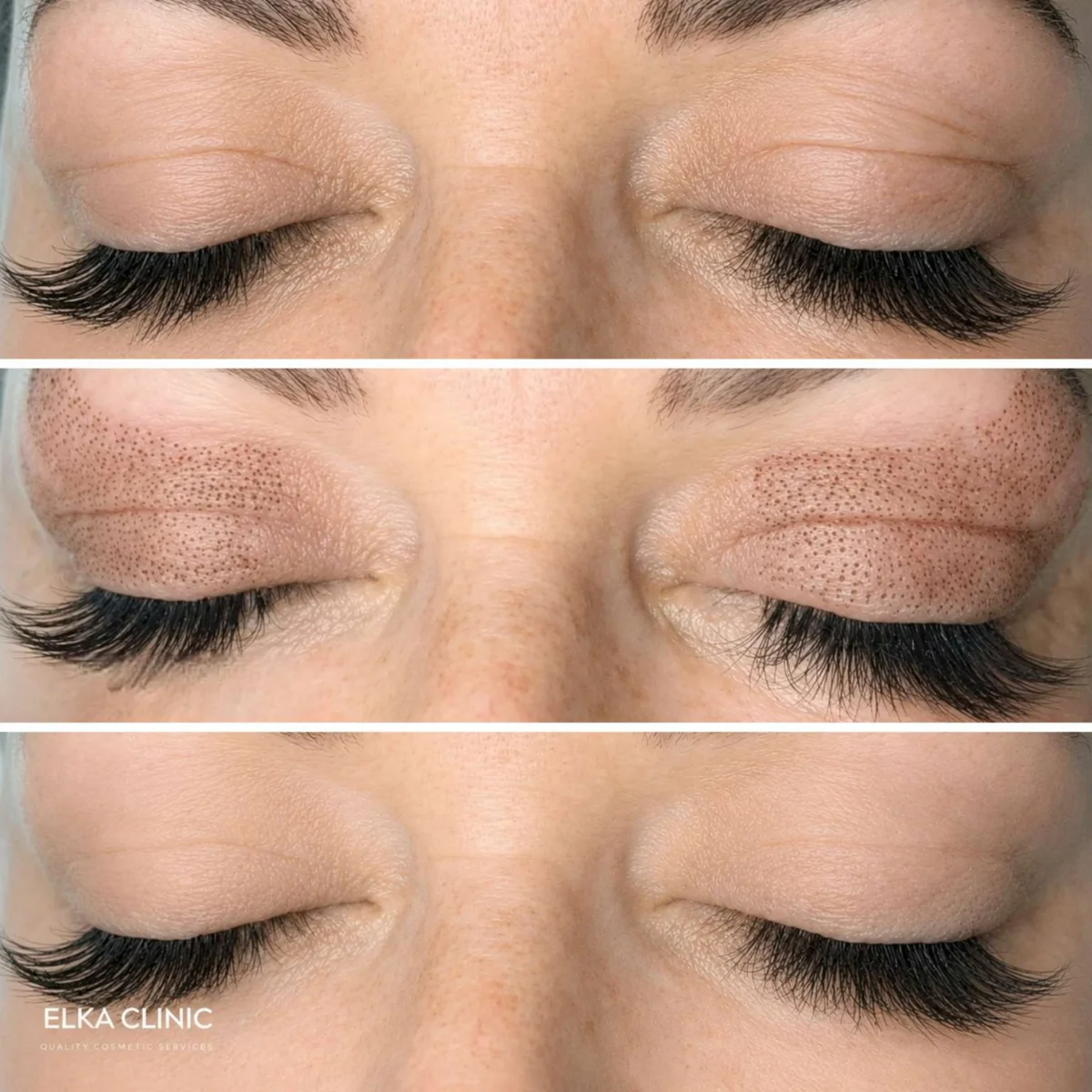
Recovery here is the part to plan for. Eyelids swell more than anywhere else on the face, and on waking on day two the swelling can be enough to narrow the eye opening. Most people take three to five days away from work or social plans.
In our experience. Nearly everyone expects the lift to be there the moment the swelling goes. Some of it is, because the immediate contraction is real, but on eyelid skin most of the change arrives quietly between weeks six and twelve as collagen remodels. That is why the review is booked at eight to twelve weeks rather than comparing photographs at two.
A second client, with mature skin and a heavier fold, is shown before treatment and again once healed. The lid platform is more visible and the fold sits higher, but the change is a genuine improvement rather than a surgical result. The skin has tightened; it has not been removed.
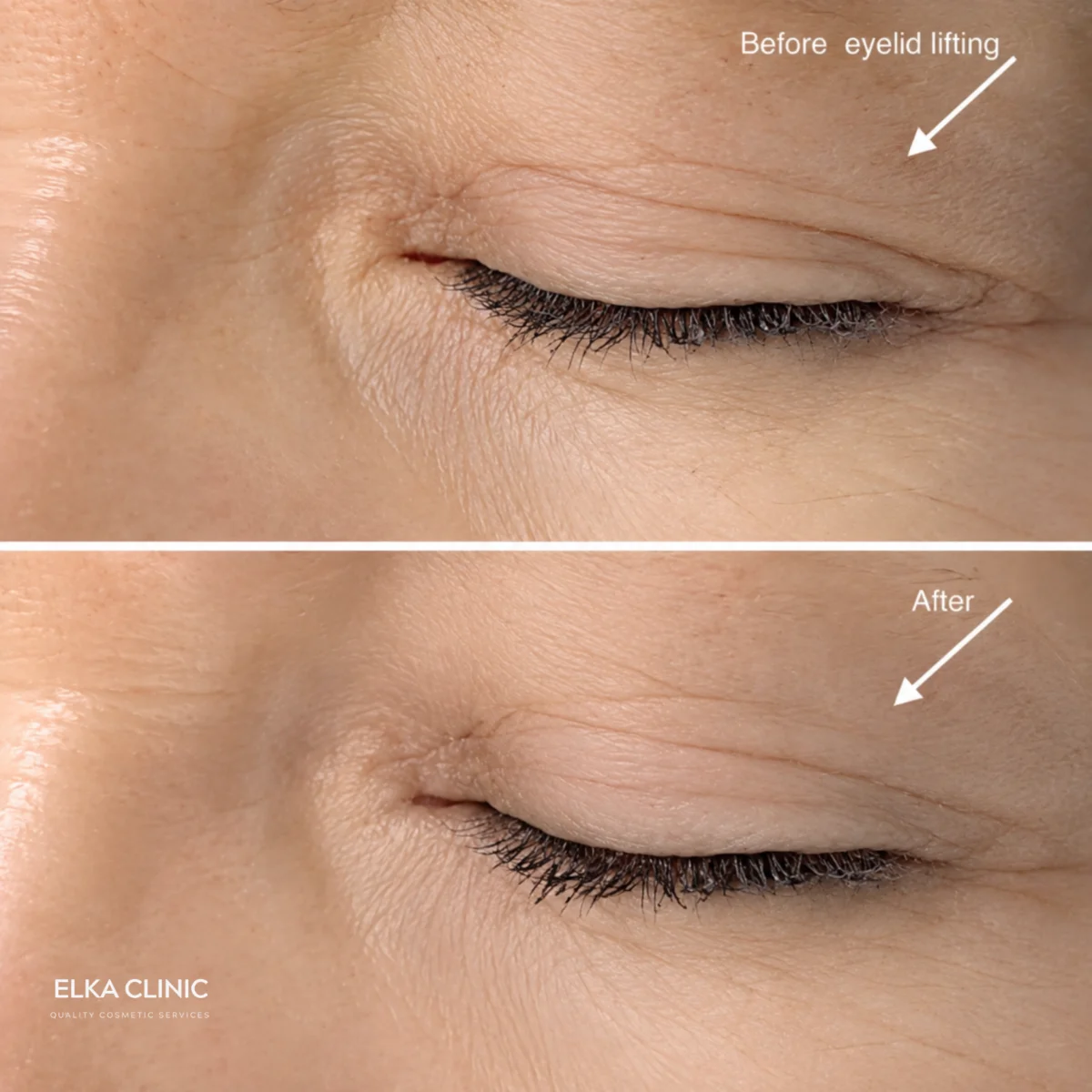
Why we treat the eye area conservatively. On thin lid skin we would rather do slightly less than we could and see you again afterwards. Adding a second, lighter session eight to twelve weeks later is straightforward; an overtreated eyelid is not something anyone can undo. Given the choice between a cautious result now and a risk taken on delicate skin, we take the cautious result every time.
Where eyelids need a surgeon. Where hooding is heavy, or the lid margin itself sits low, the appropriate answer is a medical or surgical opinion rather than repeated fibroblast sessions. Plasma Pen tightens skin; it does not remove it, and it cannot lift a heavy brow. If that is what your eyes need, we will point you towards a surgeon.
Crow’s Feet
Expect the lines you can see when your face is at rest to soften. Expect the lines that only appear when you smile to stay, because those are made by muscle rather than by skin.
In the sequence below the fan of etched lines is shallower once healed and the surrounding skin looks denser. The pattern is softened rather than removed, which is what this area does.
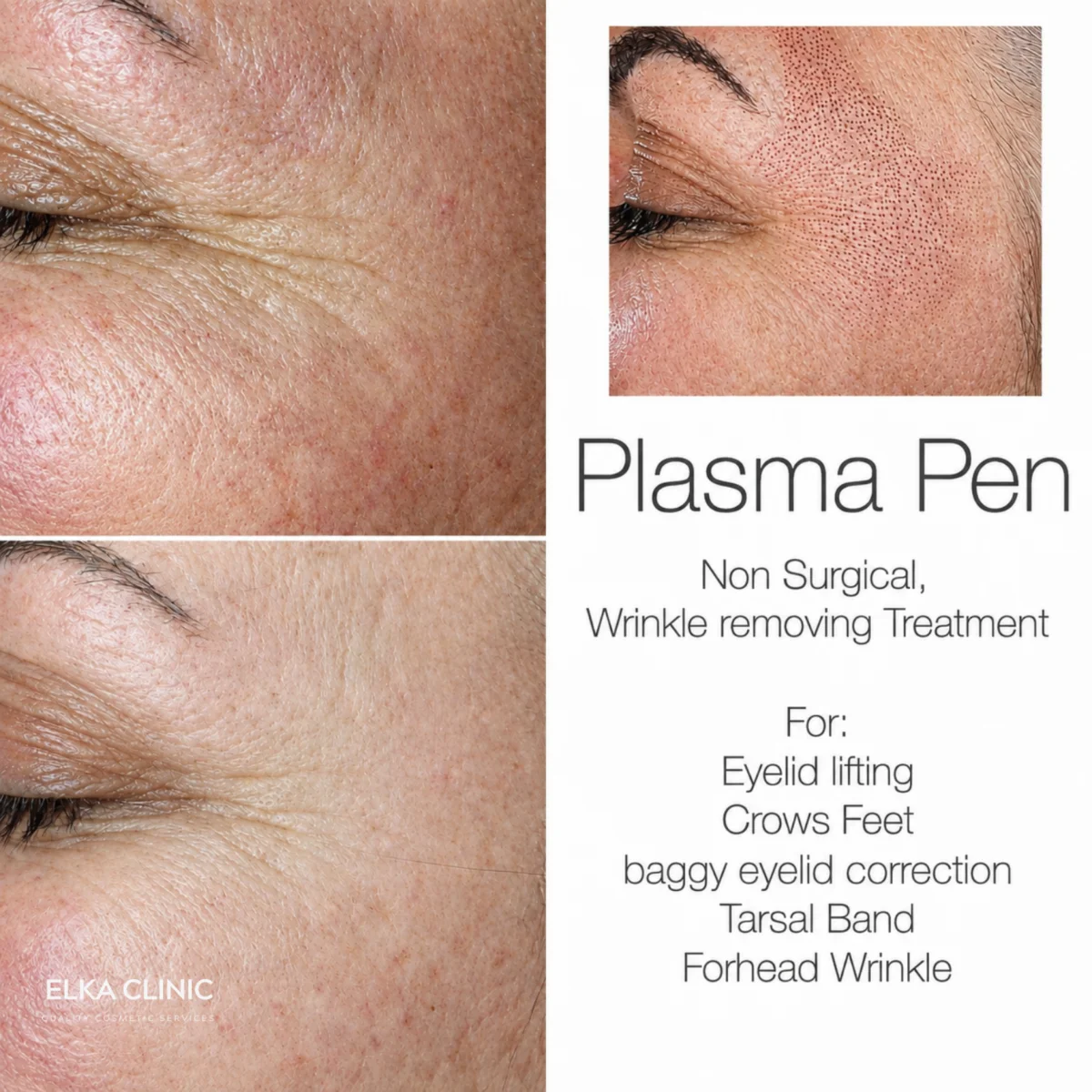
Crow’s feet and upper eyelids are commonly treated together, because both sit within one healing period and the eye area reads better when the whole region is treated consistently. The photographs below show a client before treatment and once healed across both the lid and the outer corner.
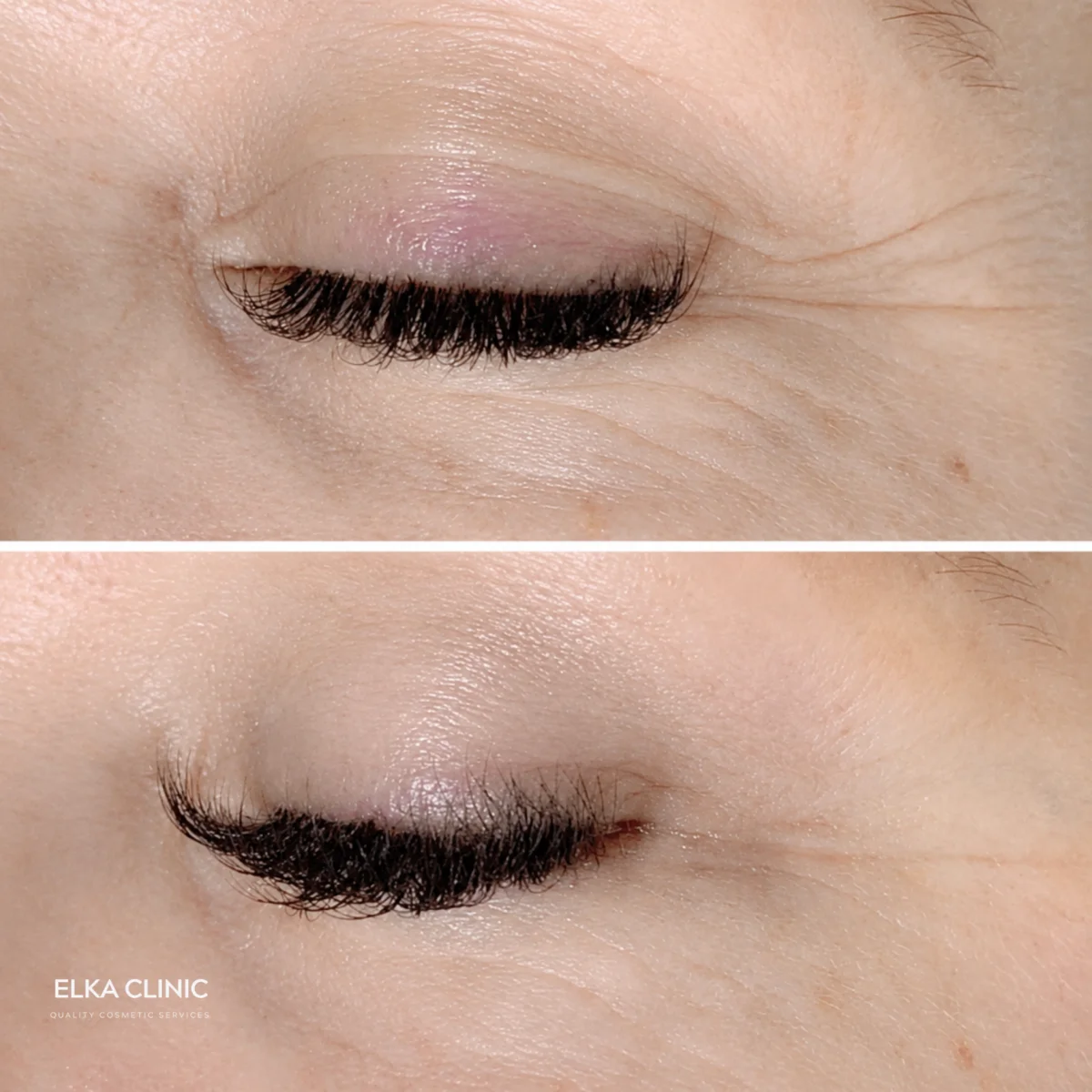
Tightening around the outer eye is generally judged at around twelve weeks in matched lighting. Sun exposure is the fastest way to lose it: this is the most sun-exposed part of the face, and daily sunscreen and sunglasses do more to protect the result than any product applied afterwards.
Forehead Wrinkles And Frown Lines
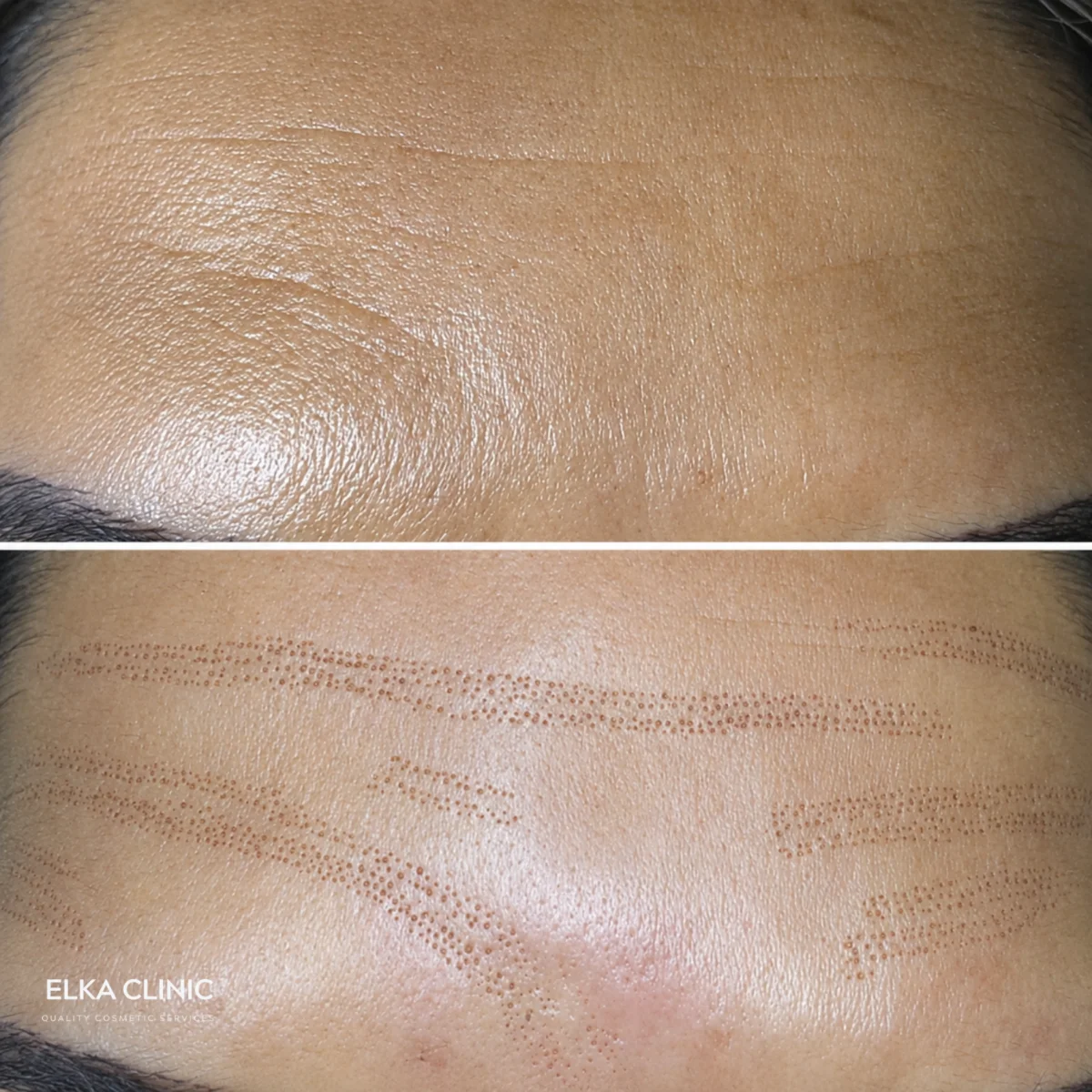
On the forehead the treatment grid follows the lines themselves, which makes the working pattern unusually easy to see immediately afterwards, and unusually hard to hide for the week that follows.
In the photographs below, rows of crusts trace each line immediately after treatment, with untreated skin left between every point. This is the stage worth planning around: the pattern is difficult to disguise, a fringe helps, and makeup does not.
Because the forehead is difficult to photograph consistently, the illustration below is included to show the full sequence in one view, including the healed stage at around six weeks. It is a labelled illustration rather than a client photograph, and it is here to set expectations about the pattern and the timeline, not to represent an individual outcome.
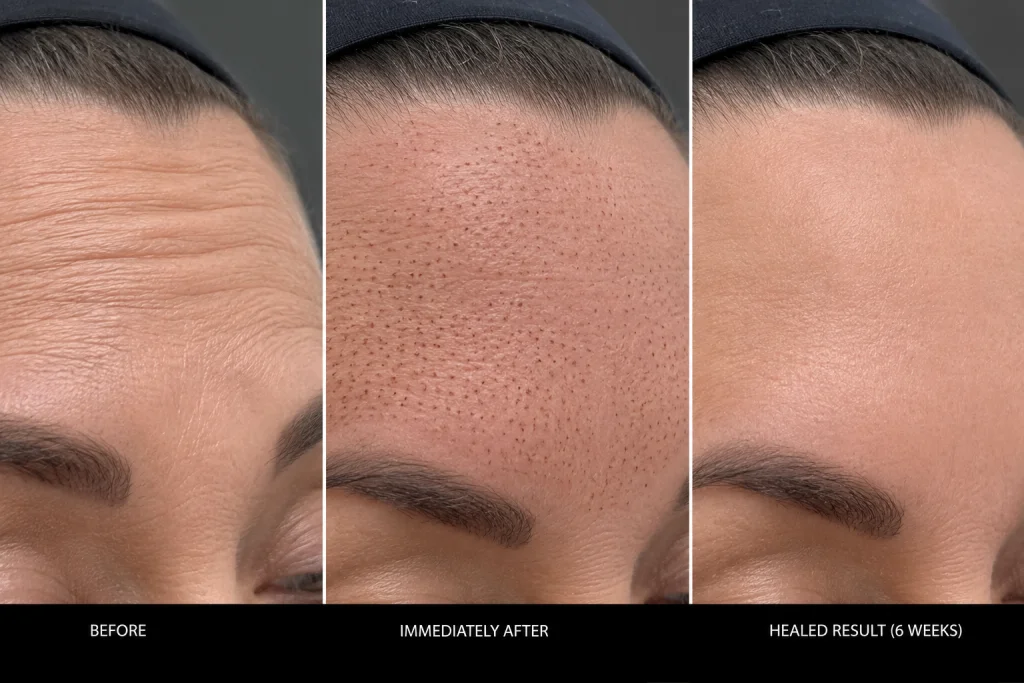
Frown lines between the brows are treated on the same principles and usually in the same appointment. They are the most movement-driven lines on the face, so the expectation we set is softening of the etched line rather than removal. Where a line disappears completely when the brow is relaxed, skin tightening is the wrong tool for it.
How we tell muscle from skin. At consultation we ask you to relax the brow completely and then look at what is left. A line still visible at rest is etched into the skin and can be softened. A line that disappears is being folded by muscle, and Plasma Pen will underdeliver on it. You will be told which of the two you have before you book.
Realistic expectation for this area. Plasma Pen works on the skin, not on the muscles that fold it. Deep, long-standing forehead furrows improve in depth and texture but remain visible, and they will continue to be recreated by normal expression. More than one session is usual, and sun protection has more influence on how long the improvement lasts than anything else you do.
Fine Lines
Shallow lines and thinning surface texture on the temples and outer cheek respond well, because the problem here is skin quality rather than descent.
In the sequence below the surface looks denser once healed and reflects light more evenly. The change is subtle, and this is an area to judge at ten to twelve weeks in the same lighting rather than in a bathroom mirror on day ten.
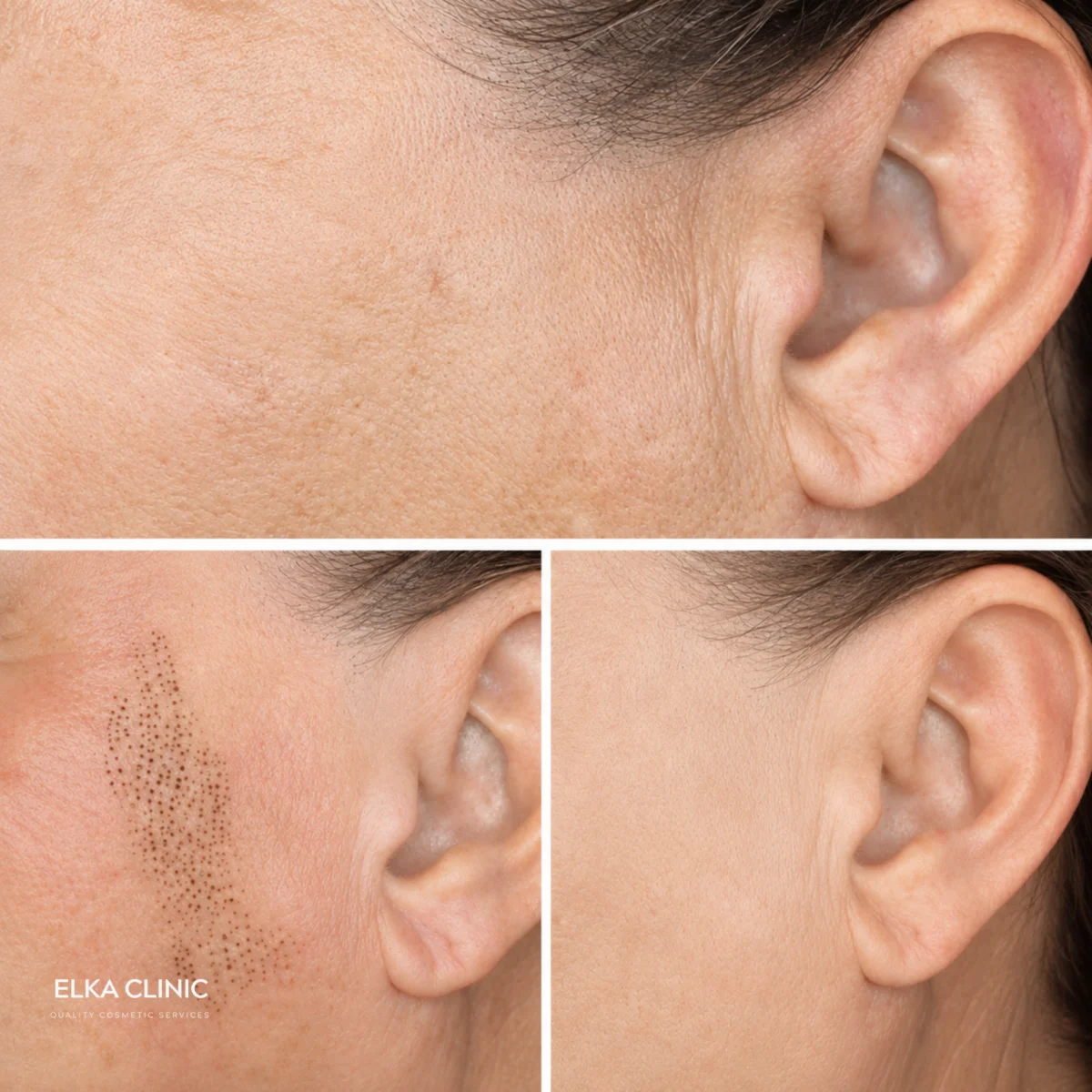
Fibroblast earns its place where a defined area needs genuine tightening rather than general resurfacing. Where fine lines are spread across the whole face, microneedling makes more sense.
Nasolabial Folds And Around The Mouth
A nasolabial fold is partly structural, and no surface treatment lifts a cheek. Expectations matter more here than anywhere else on the face.
In the three frames below the skin beside the fold is firmer once healed and the fine vertical lines on the upper lip are shallower, so the fold reads as less abrupt. The fold itself is still there. That is the scale of change this area gives.
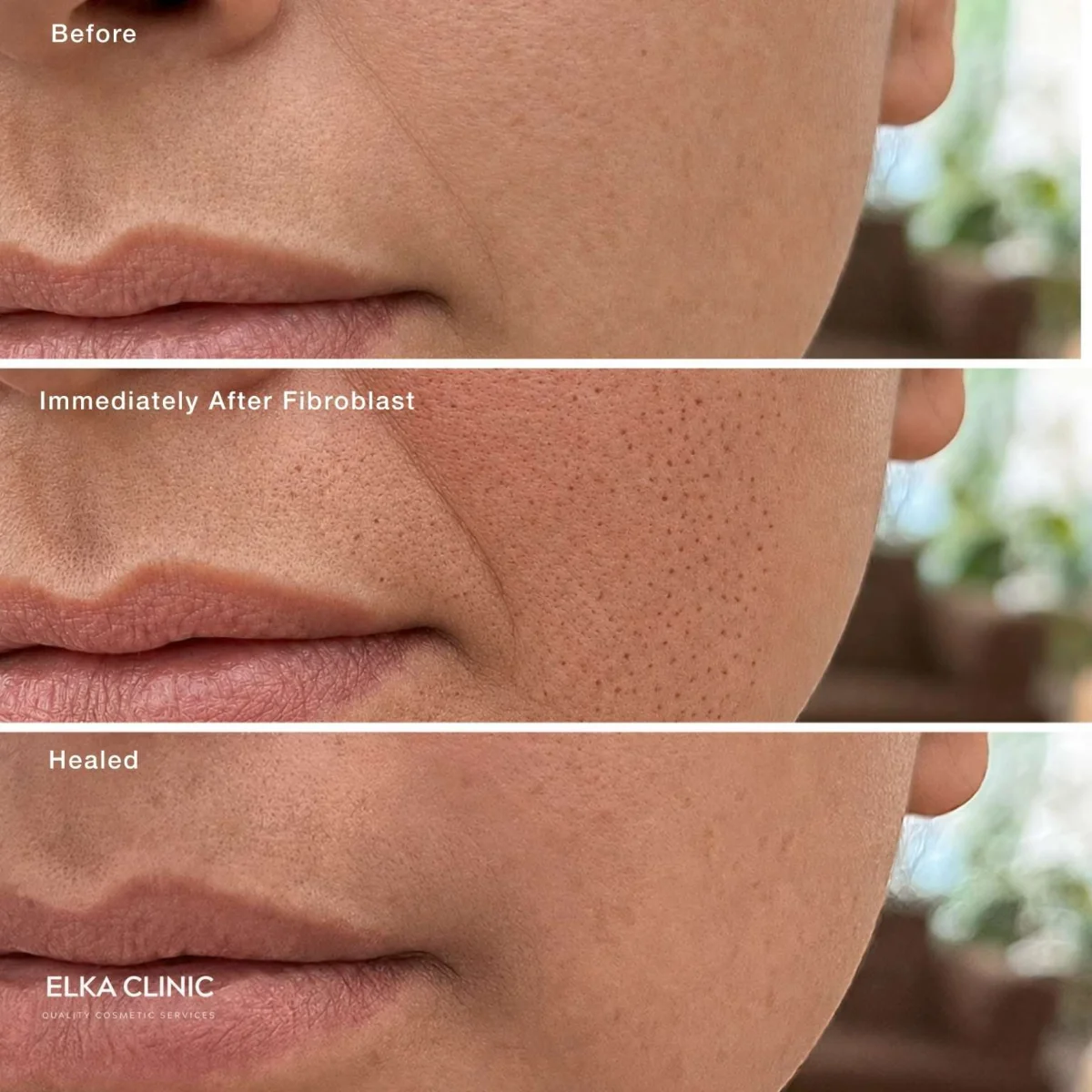
The upper lip swells on day one more than people expect, so keep food soft for a day or two. If you have a history of cold sores, treatment around the mouth can trigger a recurrence, so tell us beforehand and we will discuss preventative measures.
When we will steer you elsewhere. If the fold is deep and driven by mid-face volume loss rather than by lax skin, tightening the surface will not satisfy you. In that situation we will suggest an opinion about volume from an appropriate medical provider rather than booking fibroblast.
Immediately After: Carbon Crusts, Swelling And Normal Healing
The healing stage is visible and entirely normal, and it is the main reason people either love this treatment or regret the timing of it. Worth reading before you book.
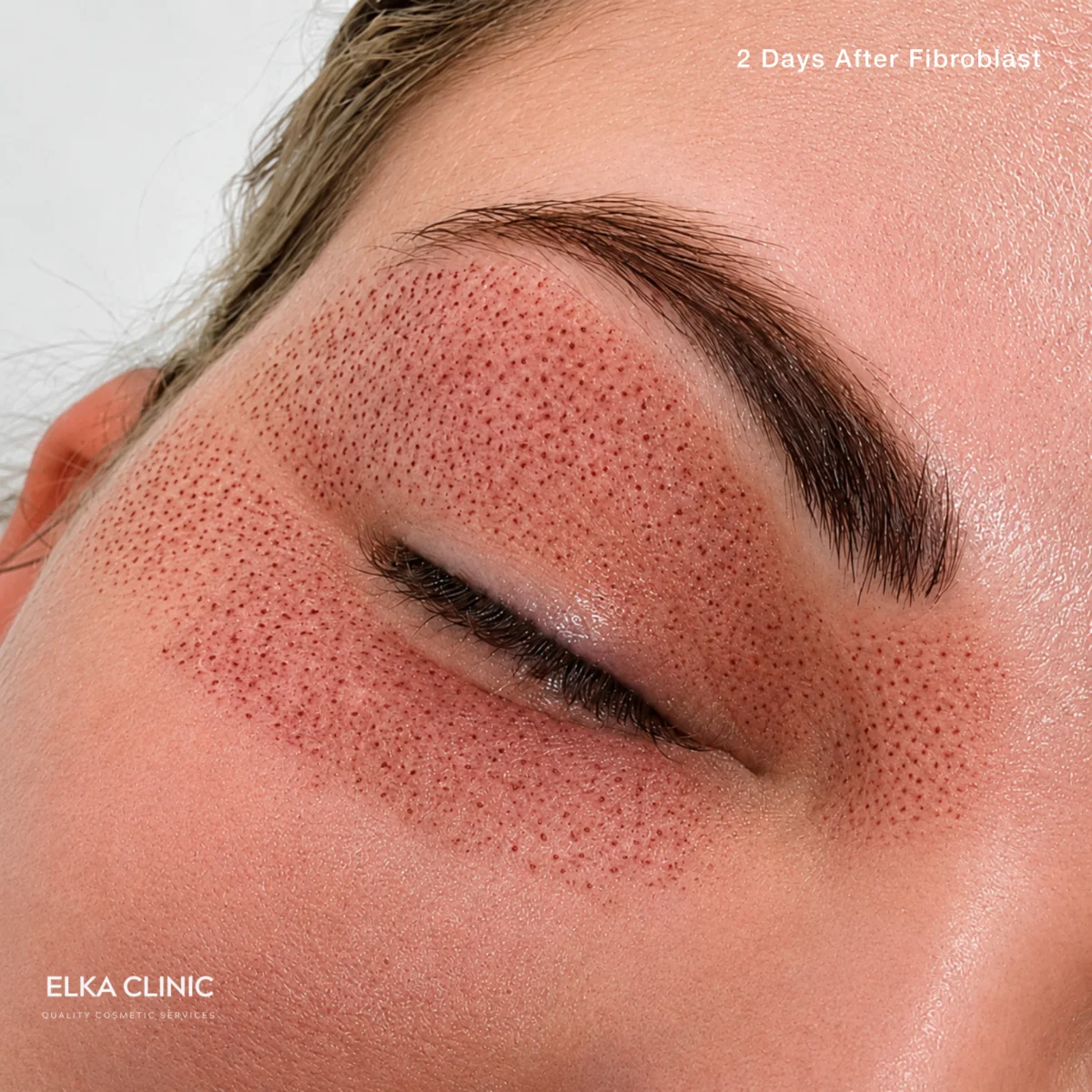
What the carbon crusts are
Each plasma arc leaves a tiny point of treated tissue on the surface. Within a few hours that point dries into a small dark crust, often described as a carbon crust. They are not scabs from a wound and they are not burns in the everyday sense; they are the skin’s own dressing, sealing the surface while new skin forms underneath.
The photograph beside this text was taken two days after treatment around the upper eyelid, brow and temple. The pattern of small dark points, the pink surrounding skin and the slight tightness are all expected at this stage.
Swelling
The eye area swells most, and eyelids can look puffy enough to change the shape of the eye for a day or two. Sleeping with the head slightly elevated and holding a cool compress over — never under — the crusts both help.
What normal looks like
Pink skin, mild tightness, and occasional itching as the crusts loosen and fall away a few at a time. The new skin underneath is pink and shiny for a while. That pinkness is part of healing, not a complication.
What to avoid completely
Picking, scrubbing, makeup over crusts, heat, swimming and active skincare. Removing a crust early is the most avoidable cause of a lasting mark. The aftercare guide gives the full list and when each can resume.
What we hear most often. The crusts are rarely what unsettles people. It is the second morning, because that is when swelling peaks and the face in the mirror looks least like the result you were hoping for. Almost every client who rings us worried rings on day two, and almost every one of them is entirely on track.
Timing your treatment. Allow at least seven days of visible healing on the face and ten on the neck, and add a buffer before any wedding, holiday or photographed event. If your calendar cannot accommodate that, book the consultation now and the treatment for a better window.
Recovery Timeline
A typical face treatment. The neck runs a few days slower throughout, and larger areas take longer than small ones.
| Stage | What you can expect | What helps |
|---|---|---|
| Day 1 | Pink, warm, tight skin with a visible grid of small dark carbon crusts across the treated area. Swelling begins and is obvious by the evening, particularly around the eyes. A mild stinging or sunburnt sensation is common. | Leave the area completely alone. Cool compress over the top of the crusts, sleep with the head elevated, nothing but the aftercare product provided. No makeup, no heat, no exercise. |
| Days 2–4 | Swelling usually peaks on the second morning and then settles noticeably each day. Crusts are firmly attached and at their most obvious. Around the eyes the lids can look puffy enough to change the eye shape briefly. | Keep the area dry and undisturbed, cleanse gently around rather than over the crusts, and continue cool compresses. This is the stage to stay home if you would rather not explain it. |
| Week 1 | From about day five the crusts begin to loosen and fall away a few at a time, usually finishing between days five and seven on the face and seven to ten on the neck. Itching as they lift is normal. New skin underneath is pink. | Let every crust separate on its own. No picking, no scrubbing, no exfoliation. Once an area is fully closed, mineral sunscreen goes on daily without exception. |
| Weeks 2–4 | Pinkness fades gradually. The treated skin can look slightly shiny or feel tight, and some people notice mild dryness. Early tightening becomes visible now that swelling has fully gone. In skin that pigments readily, temporary darkening can appear at this stage. | Daily sunscreen, a hat, gentle products only, and no active ingredients until the skin is comfortable. Makeup is fine once the surface is fully closed and calm. |
| Weeks 6–12 | Collagen remodelling continues quietly. This is when most of the visible tightening appears and where the before-and-after comparison belongs. Any residual pinkness usually resolves within this window. | Consistent sun protection, and a review appointment at around eight to twelve weeks so photographs can be compared in matched lighting and a further session considered if it is worthwhile. |
Aftercare: When You Can Resume Normal Life
These are the questions asked most often at the end of an appointment. The guide below assumes a face treatment; allow a few extra days on the neck. Where you are unsure, waiting is always the right call, because nothing on this list is worth a lasting mark.
| Activity | When you can resume | Why it matters |
|---|---|---|
| Makeup | Not while any crust remains, and not until the new skin has fully closed. In practice that is commonly day five to seven on the face. Mineral makeup first. | Applying makeup, and more importantly removing it, is exactly the friction that lifts a crust before it is ready. It also traps product in a healing surface. |
| Washing and cleansing | Keep the area dry for the first 48 hours. After that, cleanse gently around the crusts rather than over them with lukewarm water and a bland cleanser, then pat dry. | Soaking, rubbing, flannels, cleansing brushes and hot shower water all loosen crusts early. Gentle and brief is the whole technique. |
| Exercise and sweating | Gentle walking from the day after. No gym, running, heavy lifting or anything that makes you sweat until the crusts have separated, so around a week. | Sweat softens crusts, stings healing skin and carries bacteria across the treated area. Raised blood flow also adds to swelling in the first few days. |
| Sauna, steam and hot yoga | Avoid completely until the skin has closed and settled, which usually means around two weeks. | Heat increases swelling, prolongs redness and softens crusts before they are ready to lift. |
| Swimming, spas and the ocean | No pools, spas, hot tubs or ocean swimming while crusts are present. Around a week for the face and closer to ten days for the neck. | Chlorine and salt water both irritate healing skin, and open water carries a genuine infection risk while the surface is not yet closed. |
| Sun exposure | Keep the area out of direct sun entirely while healing, and treat shade, a hat and sunglasses as part of the aftercare for the first month. | Sun during or shortly after healing is the main driver of post-inflammatory pigmentation, and continuing sun exposure is the fastest way to lose the tightening you paid for. |
| Sunscreen | From the day the skin is fully closed, then every day without exception. A broad-spectrum SPF 50+, ideally a mineral formula while the skin is still new. | Ultraviolet light degrades collagen faster than any treatment builds it. In Perth this single habit influences the result more than any product you can buy. |
| Retinol, retinoids and acids | Stop around five days before treatment. Leave them off until the skin is fully closed and no longer pink or sensitive, usually two to four weeks, then reintroduce one product at a time. | Retinoids, glycolic and salicylic acids, scrubs and exfoliants all thin and irritate a healing surface, which raises the risk of prolonged redness and pigment change. |
| Vitamin C and other serums | Paused during healing. Generally comfortable again from around week three or four, once the surface is closed and calm. | Vitamin C serums are acidic and commonly sting new skin. Once tolerated, a well-formulated vitamin C alongside daily sunscreen is a sensible routine to return to. |
| Facials, waxing and other treatments | No facials, peels, waxing, threading, laser or microneedling over a treated area for at least four weeks, and confirm at your review before booking anything. | A treated area is still remodelling well after it looks normal. Stacking treatments too early risks irritation and undoes the point of a controlled, staged plan. |
| Flying and holidays | Flying itself is not a problem, but most people prefer to travel once the crusts have gone. Allow at least a week on the face, and longer before a beach holiday. | Cabin air is drying, and holidays usually mean sun, swimming and heat, which are the three things healing skin tolerates least. |
Realistic expectations. Recovery does not end when the crusts fall off. The pink stage that follows lasts one to three weeks and catches people out more often than the crusts do. Full assessment of the result belongs at around twelve weeks, not at two, and a single session usually produces visible but partial improvement.
If healing does not follow this pattern. Call 1300 216 456 or use the contact page. The signs worth calling about are listed under risks and side effects.
How Long Results Take, And What Changes Them
Results vary. Two people with what looks like the same crepey eyelid can respond quite differently, and the difference is usually age, skin quality, how much laxity is present and what happens after the appointment rather than the treatment itself.
Immediate contraction is visible once swelling settles. The larger part of the change appears between six and twelve weeks as new collagen is laid down and reorganised. Nothing here is permanent, because the skin carries on ageing after treatment as it did before it.
Age
Younger skin has more active fibroblasts and remodels faster. Mature skin still responds, but usually needs more than one session to reach the same change.
Skin quality and thickness
Thin, mobile skin such as the eyelid shows contraction readily. Thick, sebaceous skin resists it and improves more slowly. Well-hydrated skin heals faster and holds the result better.
How much laxity there is
The single biggest predictor. Mild to moderate laxity responds; significant sagging does not. If the skin can only be lifted in a handful, a surface treatment will not meet the expectation, however many sessions are performed.
Sun exposure
Ultraviolet light degrades collagen faster than the treatment builds it, and in Perth that matters more than almost anywhere. Unprotected sun also raises the risk of pigment change during healing.
Smoking
Smoking reduces blood supply to the skin, slows healing and impairs collagen production. It also causes many of the perioral lines people ask us to treat. Where smoking continues, results are less predictable, healing takes longer and the risk of a poor cosmetic outcome is higher.
General health and medication
Diabetes, autoimmune conditions, immunosuppressants, long-term corticosteroids and poor nutrition all affect wound healing, and therefore the result. Tell us about all of it at assessment.
Aftercare
The clients with the best outcomes left the crusts alone, kept the area dry, avoided heat and started sunscreen the moment the skin closed. In a treatment that works through healing, aftercare is roughly half the result.
Number of sessions
Two to three sessions are common in most areas, agreed after seeing how your skin responded to the first rather than sold in advance.
Maintenance and longevity
Tightened tissue does not loosen overnight, and many people are pleased with an area for years. We do not quote a fixed number, because that would be a guess about your skin, your age and your sun exposure. Expect to reassess it periodically.
Why we insist on matched photographs. Skin looks tighter under overhead light and looser beside a window, and memory is a poor record of either. We photograph the area before treatment and again at the review in the same position and the same lighting, because it is the only comparison worth trusting. Occasionally it shows less change than everyone hoped for, and that is a conversation worth having plainly rather than talking around.
Photographs on this page are genuine ELKA CLINIC client results, unretouched and taken in clinic. They illustrate what has been achieved for those individuals. They are not a prediction of your outcome, and no cosmetic result can be guaranteed.
Risks And Side Effects
Plasma Pen fibroblast is a controlled injury to the skin. Most of what follows is expected and temporary, but it is not a treatment without risk and you should read this before booking.
Expected after every treatment
- Swelling. Greatest around the eyes, where it can temporarily alter the shape of the eye opening.
- Crusting and scabbing. Visible, and not easily concealed.
- Redness. Occasionally longer on the neck and around the mouth than elsewhere.
- Tightness, dryness and itching as the crusts loosen and the new surface settles.
- Timings for all of the above are in the recovery timeline.
Less common, and possible
- Pigment changes. Temporary darkening (post-inflammatory hyperpigmentation) can occur, more often in skin that pigments readily and after sun exposure during healing. Loss of pigment leaving a paler mark is less common but possible, and can be long lasting.
- Infection. Uncommon, and usually associated with crusts being disturbed. Increasing pain, spreading redness, heat, yellow discharge or fever needs to be assessed promptly.
- Cold sore reactivation where treatment is performed around the mouth in someone with a history of them.
- Scarring. Uncommon after correctly performed treatment, but possible — most often where a crust has been removed early, where energy was excessive, or in people who scar easily.
- Prolonged redness beyond the usual few weeks, particularly in sensitive or reactive skin.
- Asymmetry or under-correction, which is a normal reason for a second, lighter session rather than a complication.
- Ectropion or lid retraction from over-treatment of the lower eyelid. This is precisely why the lower lid is treated conservatively, in stages, or not at all.
When to contact the clinic. Call 1300 216 456 or use the contact page if pain increases rather than settles, if redness spreads or the area becomes hot, if there is yellow discharge or a fever, if swelling worsens after day three, if a blister or cold sore develops, or if a crust comes away early. Any concern about your eye or your vision is a reason to seek medical attention immediately rather than waiting for a clinic appointment.
ELKA CLINIC provides cosmetic treatments and does not diagnose skin disease, eyelid disorders or medical conditions. Where an area needs a medical or surgical opinion, we will refer you rather than treat.
Plasma Pen, Microneedling, Laser Resurfacing Or Surgery
Four different answers to four different problems. General information to help you frame the question, not advice about your own face.
| Consideration | Plasma Pen fibroblast | Microneedling | Laser resurfacing | Blepharoplasty (surgery) |
|---|---|---|---|---|
| How it works | A plasma arc treats precise points on the surface, contracting tissue immediately and prompting fibroblasts to build collagen. | Fine needles create controlled micro-channels that stimulate collagen across a broad area without removing surface tissue. | Light energy removes or heats layers of skin to resurface and stimulate collagen, in ablative or non-ablative forms. | A surgeon removes excess eyelid skin, and sometimes fat, then closes the incision. |
| Main strength | Targeted tightening of a defined area, especially thin skin such as the upper eyelid. | Overall tone, texture, pores, scarring and fine lining across whole areas. | Resurfacing and pigment work over larger areas. | Definitive removal of excess skin. Nothing else achieves this. |
| Best suited to | Mild to moderate laxity, crepey skin, hooded upper lids and static fine lines. | Texture, acne scarring, pigmentation, dullness and fine lines across the face. | Sun damage, deeper wrinkling and pigment irregularity, depending on the device. | Genuine excess eyelid skin, or heavy hooding affecting the field of vision. |
| Visible downtime | Five to seven days of carbon crusts on the face, then one to three weeks of pink skin. | Redness for one to three days, occasionally light flaking. | A few days to two weeks or more, depending on depth and device. | Bruising and swelling for one to two weeks, plus suture removal. |
| Anaesthetic | Topical numbing applied before treatment. | Topical numbing. | Topical numbing, or more depending on depth. | Local anaesthetic, sometimes with sedation. |
| Typical sessions | One to three per area, eight to twelve weeks apart. | A course, commonly three to six, four to six weeks apart. | One to several, device dependent. | Usually a single procedure. |
| When results show | Immediate contraction, with the main change between six and twelve weeks. | Progressive across a course and for weeks afterwards. | Once healing is complete, then continuing for weeks. | Immediate, once swelling and bruising resolve. |
| Degree of tightening | Modest to moderate, and area specific. | Minimal tightening; the benefit is skin quality rather than lift. | Variable, and generally modest for laxity. | Substantial, because skin is removed rather than contracted. |
| Main risks | Pigment change, prolonged redness, infection if crusts are disturbed, rarely scarring. | Redness, temporary breakouts, infection where aftercare is poor. | Pigment change, prolonged redness, scarring, with higher risk in darker skin. | Surgical risks including bleeding, infection, scarring, dry eye and asymmetry. |
| At ELKA CLINIC | Yes, for suitable cosmetic concerns after assessment. | Yes. See microneedling in Perth. | No. | No. This requires a surgeon, and we refer rather than treat. |
The practical way to choose is to name the problem before naming the treatment. If the problem is texture and tone across the whole face, microneedling. If it is a defined area of loose, crepey skin, fibroblast. If it is genuine excess eyelid skin, a surgeon. If it is a benign lesion rather than a wrinkle, benign skin lesion removal is the relevant page.
This comparison describes treatment categories in general terms. It is not a recommendation for any individual, and suitability is determined in person.
When Plasma Pen Is Not The Best Option
Plasma Pen fibroblast is the right answer for a defined area of mildly to moderately lax, crepey or finely lined skin. It is the wrong answer for lost volume, for lines made by muscle, for genuine excess skin, and for anything that needs a diagnosis rather than a cosmetic treatment. Recommending something else is a normal outcome of an assessment here, not an unusual one.
These are the alternatives we suggest instead, and the reasoning behind each.
Microneedling
Where the concern is overall tone, texture, pores, dullness, acne scarring or fine lining spread across the whole face rather than concentrated in one area. It covers broad areas in a single sitting, costs less per treatment and asks for a fraction of the downtime. See microneedling in Perth and the skin treatment gallery.
A surgical or oculoplastic opinion
Where there is genuine excess eyelid skin, heavy hooding, hooding that affects the field of vision, a lid margin that sits low, or a history of eyelid surgery. Blepharoplasty removes skin; fibroblast contracts it. Repeated sessions are not a substitute for the right procedure, and we refer rather than treat.
An assessment of volume rather than skin
Where the concern is a deep nasolabial fold, a hollow cheek, a tear trough or mid-face descent. These are not skin-quality problems, and tightening the surface will not lift them. The recommendation is an opinion from an appropriate medical provider who works with facial volume.
Treatment aimed at muscle movement
Where a line vanishes completely when the face is at rest, such as many frown lines and some forehead lines, the cause is repeated movement rather than lax skin. That is a prescriber-led area of practice and it is not offered at ELKA CLINIC, so we will explain the distinction and leave the choice with you.
Your GP or a dermatologist
Where anything might not be cosmetic: a new, changing or bleeding lesion, a pigmented spot that is evolving, persistent dermatitis or rash, an undiagnosed drooping eyelid, unexplained swelling, or a wound that has not healed. ELKA CLINIC does not diagnose skin disease or eyelid disorders, so a medical opinion comes first and treatment waits.
Benign skin lesion removal
Where the concern is a lesion rather than a wrinkle. Skin tags, milia, seborrhoeic keratoses and similar benign lesions are addressed with a different technique and a very different appointment. See benign skin lesion removal in Perth.
Cosmetic tattooing
Where the real concern turns out to be definition or colour rather than firmness. A lip border that has faded, sparse brows or a lash line that has lost its definition are answered by lip blush, nano brows or eyeliner tattooing rather than by skin tightening. Different problem, different tool.
Doing nothing, for now
Sometimes the sensible answer is to wait: the concern is mild, the visible healing does not fit your year, you are pregnant or breastfeeding, a course of isotretinoin has recently finished, or a tan needs to fade. Reviewing the area later is a legitimate plan, and a consultation now with treatment at a better time often works well.
If this describes your concern. Suitability is what determines whether someone is pleased at twelve weeks. Mention it when you get in touch and we will point you in the right direction.
Why Clients Choose ELKA CLINIC For Plasma Pen Fibroblast
The practical reasons clients give us, and the things we do not compromise on.
A conservative treatment philosophy
Settings, spacing and depth are chosen for the skin in front of us, and the eye area is deliberately treated in stages. A second, lighter session is easy to add later. Overtreated skin cannot be reversed, so we take the cautious side of every judgement.
Suitability assessed before treatment
We look at whether the concern is skin quality, volume, muscle movement or true excess skin, and we say which. Being told that fibroblast is not the right treatment is a normal outcome here.
Unhurried numbing
Topical numbing is applied and then given the time it actually needs, usually thirty to sixty minutes and longer on sensitive areas. It is the difference between a tolerable appointment and an unpleasant one, and it is not shortened to fit a schedule.
Appointments long enough to do it properly
Time is booked for assessment, photographs, numbing, treatment and a full aftercare explanation. Fibroblast is a point-by-point treatment, and rushing the grid is how spacing and results suffer.
Aftercare explained, then written down
Aftercare is roughly half of the result in a treatment that works through healing. It is talked through at the appointment and provided in writing, and the clinic is contactable on 1300 216 456 if something does not look right.
Natural-looking outcomes
The aim is skin that looks like better-quality skin, not a face that looks treated. On eyelids that means a lid that sits higher and reads more open, judged against your own photographs rather than against someone else.
Genuine client photography
Every clinical photograph on this page is an ELKA CLINIC client, unretouched, including the immediately-after stage that most clinics leave out. Where an image is an illustration it is labelled as one. You can also read skin treatment reviews from clients.
Established in Subiaco since July 2015
A cosmetic clinic with a long track record in one location, founded by Ellie, who still consults and leads the team. You can read about the team and their training before you book anything.
Clear pricing and payment plans
A personalised quote is given after assessment rather than a number invented over the phone, and current pricing and availability are visible on the online booking page. Flexible payment plans are available for all treatments.
ELKA CLINIC provides cosmetic treatments only. Nothing on this page is a diagnosis, and no cosmetic result can be guaranteed for any individual.
Plasma Pen Fibroblast FAQs
The questions we are asked most often before a first appointment, answered plainly.
What is Plasma Pen fibroblast skin tightening?
Plasma Pen fibroblast is a non-surgical cosmetic treatment that tightens loose skin and softens wrinkles. A fine tip is held just above the skin and a small arc of plasma energy treats a precise point, contracting the tissue immediately and prompting the fibroblast cells in the dermis to produce new collagen and elastin.
Nothing is injected and nothing is cut. Small carbon crusts form over the treated points and separate on their own in about five to seven days, and the collagen change continues for roughly six to twelve weeks.
Is Plasma Pen the same as a non-surgical eyelid lift?
A non-surgical eyelid lift is the common name for Plasma Pen fibroblast applied to the upper eyelids, so the terms are used interchangeably in cosmetic clinics. It is important to understand what the name does and does not mean.
The treatment tightens the existing lid skin so the lid sits higher and reads more open. It does not remove skin or fat, and it is not a substitute for blepharoplasty where there is genuine excess skin. Where hooding is heavy, a surgical opinion is the right starting point.
Does Plasma Pen fibroblast hurt?
A topical numbing product is applied first and given time to work, which makes the treatment tolerable for most people. The usual description is a series of brief hot pinpricks rather than sustained pain.
Sensitivity varies by area. The upper lip, the area around the eyes and the neck are generally more sensitive than the cheeks or forehead. Afterwards the area feels tight and mildly sunburnt for a day or so.
How long is the downtime?
Plan for five to seven days of visible carbon crusts on the face, and seven to ten days on the neck. Swelling is worst on the second morning, particularly around the eyes, and settles from day three.
Once the crusts separate the skin underneath is pink for a further one to three weeks. Most people take three to five days away from work or social plans, and we recommend allowing a buffer before any photographed event.
How many sessions will I need?
One session produces a visible but partial change in most areas. Two to three sessions spaced eight to twelve weeks apart is a common plan where a meaningful improvement is the goal.
The interval matters because collagen remodelling needs to finish before the area is reassessed. The number of sessions is agreed after seeing how your skin actually responded, not sold as a package in advance.
When will I see the results?
There are two stages. Immediate contraction becomes visible once the swelling settles, usually within the first two weeks. The larger change appears gradually between six and twelve weeks as new collagen is laid down and reorganised.
For that reason we compare photographs at around eight to twelve weeks in matched lighting rather than judging the outcome at two weeks.
How long do the results last?
The tightening achieved does not simply reverse, and many people are pleased with a treated area for a long time. What the treatment cannot do is stop ageing, so the skin continues to change afterwards as it did before.
We do not quote a fixed number of years, because that would be a guess about your age, your skin and your sun exposure. Sun protection and not smoking have more influence on longevity than anything else.
Can Plasma Pen treat lower eyelids and under-eye bags?
Fine crepey texture on the lower lid can be treated in selected cases, conservatively and often in stages. It is done carefully because the lower lid is unforgiving of over-treatment.
Under-eye bags are a different problem. They are usually caused by fat pads pushing forward, and tightening the surface of the skin does not address them. If puffiness is your main concern, this is not the right treatment for it.
Is Plasma Pen safe for darker skin tones?
Risk of pigment change after any controlled injury rises with the amount of pigment in the skin. Treatment is most predictable in Fitzpatrick I to III, can be performed cautiously in Fitzpatrick IV with a test patch and strict sun protection, and carries materially higher risk of post-inflammatory hyperpigmentation in Fitzpatrick V and VI.
In richer skin tones we will often recommend an alternative rather than proceed. A lasting pigment change is a worse cosmetic outcome than the line being treated, and declining to treat is a legitimate answer.
Will Plasma Pen leave scars?
Scarring is uncommon after correctly performed treatment on suitable skin, but it is possible. The risk rises with excessive energy, with treating too aggressively in one session, and with how the crusts are managed at home.
Removing a crust before it separates naturally is the most avoidable cause of a lasting mark. If you have a history of keloid or hypertrophic scarring, tell us at assessment, because it may mean the treatment is not appropriate for you.
When can I wear makeup again?
Not while any crust is present, and not until the new skin underneath has fully closed. In practice that usually means waiting until the crusts have separated on their own, commonly around day five to seven on the face.
Applying makeup over crusts, and removing it afterwards, is exactly the friction that lifts a crust early. Once the skin is closed, mineral makeup and daily sunscreen are the first things to reintroduce.
Can Plasma Pen replace a blepharoplasty?
No. Blepharoplasty removes excess eyelid skin surgically; Plasma Pen contracts the skin that is there. They are different procedures with different limits.
Where hooding is mild to moderate, fibroblast can give a genuine improvement without surgery. Where there is true excess skin, or the hooding affects your field of vision, a surgeon is the appropriate person to see, and we will refer you.
Should I choose Plasma Pen or microneedling?
Name the problem first. If the concern is overall tone, texture, pores, acne scarring or fine lining across the whole face, a course of microneedling generally gives a better return with far less downtime.
If the concern is a defined area of loose, crepey skin such as a hooded upper lid, fibroblast is the treatment designed for that. Some people have both at different times, spaced so that each area has fully healed first. Our microneedling page and the comparison table above set out the differences.
Who should not have Plasma Pen fibroblast?
Treatment is postponed during pregnancy and breastfeeding, and where there is active infection, inflammation, a cold sore or broken skin in the area. It is not appropriate where there is a history of keloid scarring, uncontrolled diabetes, recent isotretinoin use, or medication and conditions that significantly impair healing.
It is also the wrong treatment where the real concern is volume loss, purely dynamic lines, or genuine excess skin. Recent sunburn or a fresh tan means waiting. Everything relevant is discussed at assessment, which is why suitability is confirmed in person rather than online.
Can I exercise, swim or fly after treatment?
Avoid anything that heats the skin or makes you sweat heavily while the crusts are in place, so no gym, sauna, steam, hot yoga or swimming pools for the first week. Sweat and chlorine both increase the risk of irritation and infection.
Flying is not a problem in itself, but cabin air is drying and a holiday usually means sun, so most people prefer to travel after the crusts have gone and with good sun protection organised.
How much does Plasma Pen fibroblast cost in Perth?
Cost depends on the area treated, its size and how many areas are addressed in one appointment, so a personalised quote is provided after assessment rather than over the phone. Current pricing and available appointment times are shown on our online booking page.
Flexible payment plans are available for all treatments. Cosmetic skin tightening is not covered by Medicare or by private health insurance extras.
Is Plasma Pen fibroblast permanent?
No, and any clinic promising permanent tightening is overstating it. The treatment produces a real change in the skin, but the skin continues to age, and sun exposure, smoking and general health all influence how long the improvement is enjoyed.
Think of it as an improvement to be maintained and periodically revisited rather than a one-off fix.
What age is Plasma Pen fibroblast suitable for?
There is no ideal age, only an ideal degree of laxity. In practice most clients are between their late thirties and their sixties, because that is when skin has usually lost enough firmness to respond visibly but has not yet developed the excess that needs surgery. Treatment is for adults only.
Younger skin has more active fibroblasts and tends to remodel faster and more completely. Mature skin still responds well but often needs more than one session to reach the same visible change, and takes a little longer to settle. Age is far less important than how the skin behaves when it is gathered gently at assessment.
Can men have Plasma Pen fibroblast?
Yes. Hooded upper eyelids, forehead lines and crepey skin around the eyes are common reasons men book, and the treatment is performed in exactly the same way.
Two practical differences are worth knowing. Facial hair in or near the treated area needs to be discussed at assessment, because shaving is paused while crusts are present. And men who spend long periods outdoors need to think realistically about sun protection afterwards, since ongoing unprotected sun exposure is the fastest way to lose the result.
Can Plasma Pen fibroblast be repeated on the same area?
Yes, and for many areas repeating it is part of the plan rather than a sign something went wrong. Sessions are spaced eight to twelve weeks apart so that collagen remodelling from the previous treatment has finished before the area is reassessed.
Areas can also be treated again years later if you feel it is warranted, provided the skin has healed fully and is otherwise suitable at that time. What we do not do is treat the same area repeatedly at short intervals in pursuit of a result the technique cannot deliver.
Can Plasma Pen make wrinkles or my skin look worse?
Temporarily, yes, and that is expected. For the first week the treated area carries a grid of dark carbon crusts and looks worse than it did before, and swelling in the first two days can be significant around the eyes. Pink skin then persists for one to three weeks. None of that is a bad outcome; it is the healing stage.
A genuinely worse long-term outcome is uncommon but possible. The realistic risks are a lasting pigment change, prolonged redness, or a mark where a crust was removed before it separated. Those risks are reduced by careful assessment, conservative settings, a test patch where skin type warrants it, strict sun protection and leaving the crusts alone. Where the risk is judged too high for your skin, the right answer is not to treat.
When can I use retinol, vitamin C and my usual skincare again?
Stop retinol and other retinoids, glycolic and salicylic acids, scrubs and exfoliants around five days before treatment. Afterwards, use only the aftercare product provided until every crust has separated and the new skin has fully closed.
Vitamin C serums are acidic and commonly sting new skin, so they are usually comfortable again from around week three or four. Retinoids and acids wait until the skin is no longer pink or sensitive, generally two to four weeks, and are reintroduced one product at a time. Sunscreen is the exception and goes back on the day the skin closes. The aftercare table above sets out each of these in turn.
Where To Go Next
Fibroblast is one part of the skin work done at ELKA CLINIC. These pages cover the treatments and the practical details most often asked about alongside it.
- Microneedling Perth — the better choice where the concern is overall tone, texture, scarring or fine lining across the whole face.
- Benign Skin Lesion Removal Perth — Plasma Pen used for skin tags, milia and selected benign lesions rather than for wrinkles.
- Skin treatment FAQ — questions about skin treatments at the clinic, aftercare and how treatments are combined.
- Flexible payment plans are available for all treatments.
- About ELKA CLINIC — the team, their training, and how the clinic works.
- Contact and location — where to find us in Subiaco and how to reach the clinic.
- Skin treatment reviews — what clients say about skin treatments at the clinic, in their own words.
- Skin treatment gallery — further before and after photography from skin treatments at ELKA CLINIC.
- General FAQs — appointments, policies and how bookings are handled.
- Booking and current pricing — live availability and up-to-date pricing for treatment and consultation.
Consultation or treatment?
You are welcome to book your treatment directly. If you would like professional advice before deciding, you can also book a consultation. At a consultation the area is assessed in good light, the options are explained, and if Plasma Pen is unlikely to give you the result you want, we will say which treatment might. Flexible payment plans are available for all treatments.
Book Plasma Pen Fibroblast In Perth
Cosmetic skin tightening, assessed individually, with a clear view of what it can and cannot achieve for your skin.
3/29 Hood Street, Subiaco WA 6008 · 1300 216 456 · contact@elkaclinic.com.au